
EXPLORE
ST.FILLANS


Your Local Weather
Current Weather Forecast report for St Fillans
Traffic Reports & Road Works
For real-time updates on Scotland’s trunk roads visit Traffic Scotland X (twitter) account.
Location
St Fillans is located at the east end of Loch Earn on the A85 in the central highlands of Scotland. View Map
St Fillans Bus Times
St Fillans Defibrillator
optimised for Google Maps and
on the Circuit National Network and
on the Trossaches Search and Rescue free online Defib Locator App
Loch Lomond & The Trossachs National Park
The National Park boasts some of the most stunning scenery in the world.
St Fillans Planning Applications
St Fillans Waste and Recycling Calendar
St Fillans Phone Book
ABOUT ST. FILLANS
St. Fillans is a pretty, picturesque conservation village situated within Loch Lomond and the Trossachs National Park. We are a friendly little village consisting of around 200 residents.
In and around St. Fillans you can enjoy walking, golf, fishing, canoeing, boating, good local food, gardens, history, bird watching, Munro-bagging or just sitting in the sun feeding the resident ducks.
It is under an hour and a half’s drive from both Glasgow Airport (64 miles) and Edinburgh Airport (59 miles) and one hour 50 minutes from Glasgow Prestwick Airport (87 miles).
Loch Earn is a beautiful expanse of freshwater which stretches due west of St Fillans for nearly 7 miles to Lochearnhead at its western end. It is one of the deepest lochs in Scotland at 87m.

HERITAGE
St Fillans takes its name from a Celtic missionary from Munster, in Ireland, called Faolan, known as St Fillan the Stammerer or more likely, St Fillan the Leper. He came to Scotland in the 6th Century AD and established his ‘headquarters’ on the hill of Dundurn, with the intention of converting the local Picts to Christianity.
WILDLIFE
The area boasts a rich diversity of habitats and species, highlighted by numerous birds like the Chaffinch, Goldfinch, and rare sightings of Kingfishers. Ospreys and Buzzards are notable raptors. Water margins and upland areas host a variety of wildlife, including Red Squirrels, Otters, and Red Deer. Conservation efforts focus on protecting these species through designated scientific interest sites. Local tours offer opportunities to explore this wildlife diversity further.
SANDISON HALL
The Sandison Hall has been an important part of St Fillans life for more than 100 years. It was built in 1894 to rehouse a library originally established in the village school, which at that time was in a barn on the site of the Four Seasons Hotel. Alexander Sandison had retired to live in St Fillans after making a small fortune from trading in the Far East. He was not only widely travelled but well-educated, and was eager to share his interests in the Arts and Books with his fellow villagers, so inaugurated one of Scotland early lending libraries. Up to three books could be borrowed free for a week by village residents. A charge of sixpence per week was levied on summer visitors.
On his death in 1889, Sandison bequeathed the whole library to be held in trust for the benefit of the village, together with a sum of money for its upkeep and, if necessary, to erect a new building to accommodate it.
Five years later the Trustees decided the time was right for a more permanent legacy and the result was the Sandison Library Hall. In 1894 it was built and furnished for £168-11s-6d. The external cladding, still in evidence, was corrugated iron, very fashionable at the time.
Whilst retaining its main purpose as a library, the Hall soon became a venue for social functions such as dances and whist drives. More recently there has been a big increase in use by local clubs and societies.
KEEP UP WITH VILLAGE NEWS
The Village News page keeps you up to date on all the latest happenings in St Fillans from wind farm developments, the Loch Earn railway path project and the hospital lift scheme.

An t’ Eilean Biodiversity Project

Minutes of the Community Council Meeting on 19th August 2026
Loch Lomond & Trossachs – Camping Management Byelaws Review

BEAR Scotland Layby Improvement Works

The Sandison Hall – Annual Subscription 2026
Minutes of Sandison Hall AGM 13th February 2026

Loch Earn Railway Path Project – June 2026
Minutes of the Community Council Meeting on 20th May 2026

Village Defibrillator update

Village CPR / Defibrillator Training May 2nd and 30th (updated 17th March)
LOCAL BUSINESS SPONSORSHIP


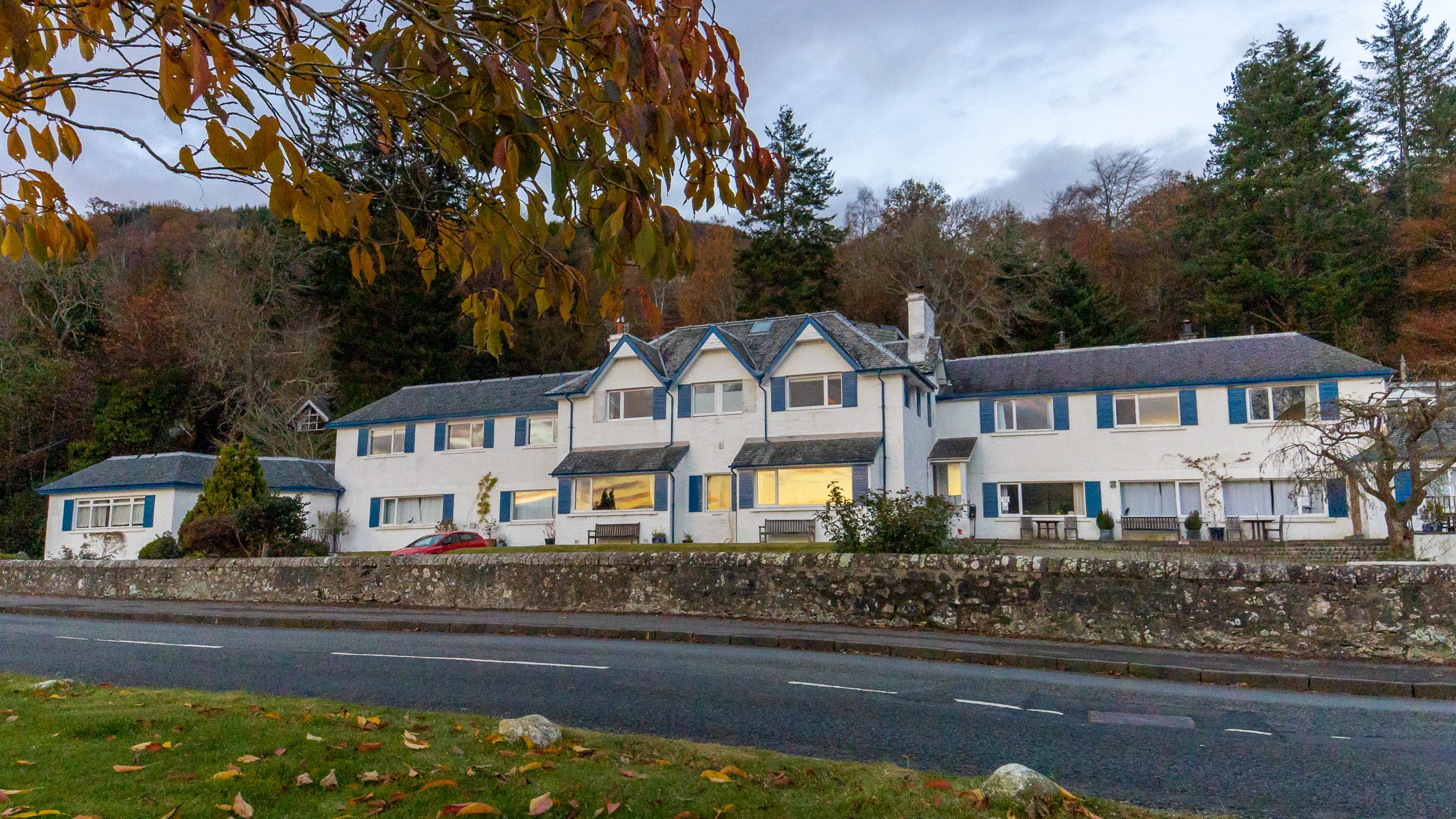


Odds and Ends

The Crocodile Rock

The Frog Stone
The Frog and the Crocodile
When you approach the village from the East you will pass two well-known local landmarks: the Crocodile Rock (also known as Craggan Croc and on Apple & Google Maps as the St Fillans Monster) and the Frog Stone.
The Crocodile Rock lies north of the A85 about half a mile from the 30mph sign. It sits high off the road on what was once the Lochearnhead to Comrie railway line embankment. The track is now a popular walking and cycle route. It was painted sometime in the early 1900s and is attributed to a member of the Gibson family, well known and respected in Strathearn.
View Map directions from Station Road to the St Fillans Monster
The “blink-and-you’ll-miss-it” Frog Stone lurks right at the roadside very near the 30mph sign, again on the north side of the road.
Hover over the image to flip between Crocodile and Frog
The Fairy Stone
In November 2005, St Fillans made the national news. A developer, building houses at the east end of the village, not far from Dundurn, was persuaded to (literally) change his plans to avoid disturbing a large rock under which, according to local folklore based on the area’s Pictish past, fairies are believed to live. In the end, the rock remained in place, becoming a feature within the housing development.
The Planning Department had no specific guidelines on fairies but a spokesman said: “Planning guidance states that local customs and beliefs must be taken into account when a developer applies for planning permission.”
Hover over image to flip between The Fairy Stone before development and after development

The Fairy Stone before development

The Fairy Stone after development
Taking inspiration from the Crocodile and the Fairy Stone, the following short story was penned by the Granddaughter of St Fillans residents, Dave & Lynda Pryde. At the time Emma Pryde attended Woodmill High School in Dunfermline but for inspiration for her story, she drew largely on some of our weel-kent local landmarks………enjoy!
The Stone Dragon
Sometime in the early 1900s, far in the North of Scotland, an old railway worker was going about his day on the hills of Glen Tarken when he came across an oddly shaped rock which he thought resembled the head of a stone dragon. To humour himself he rushed home to find brushes and pots of paint. When he returned to the hills, he then painted the face of a fierce dragon baring his teeth onto the large stone. However, little did the man know that this was in fact a real, ancient dragon whose story had been long forgotten.
Between the extinction of the dinosaurs and the dawn of man there was a period of time where the world was dominated by magical and mythical creatures. Some of the most powerful of these creatures were the fairies and the dragons. In this age, the fairies roamed the highlands of Scotland using their charms to bring the day and night. The fairies loathed the dragons, whose enchantments brought the changing of seasons and weather.
One particular herd of fairies lived in Glen Tarken where Draco, the last dragon, dwelt. The fairies wanted him to leave as he caused harsh and sudden changes to the seasons while they wanted more of the long summer days full of warm, bright sunlight. So, the fairies devised a plan to trick the dragon.
The interesting thing about dragons is that they can only come out during the night, when the moon casts white light on the hilltops and the stars dance in the sky. If one were to be caught in sunlight, they would instantly begin to harden and turn to cool stone.
One breezy Autumn day, Draco lay in a deep sleep under the orange hills of the glen; the fairies gathered at the entrance to the hole where he lay and using their magic, cast a pale light down into the hillside to make it look as though the moon was out. Draco yawned and stretched before making his way out into the open. Once almost fully out, the fairies stopped their trick and warm light shone onto the dragon’s scales. The dragon roared out in pain and he realised he had been tricked, desperately he tried to slither back out of the sunlight in retreat, but it was too late.
Draco turned to stone with only his head poking out the side of the hill, frozen with his mouth open as he cursed the fairies in his final moment. His curse trapped the fairies inside of a large stone on the far side of the glen, where they remained for the rest of time, made to grant the wishes of anyone who left an item on the rock as payment in return for their wish.
To this day you can still wander the glen and visit the fairy stone to make a wish or to see the stone head of the last dragon, who is forever trapped on the amber hillside of Glen Tarken.
Emma Pyrde, 2020
WHAT TO DO?
St Fillans offers a diverse range of activities for visitors.
Highlights include guided wildlife walks and tours by Aquila Wildlife & Nature CIC, exploring local flora and fauna.
The Beithir’s Lair Play Park provides entertainment for both children and adults, featuring educational and fun challenges.
The BLiSS Trail showcases art installations across four villages, celebrating innovation and design.
For hiking enthusiasts, the Breadalbane Clan Ring Walk presents a six-day journey through stunning landscapes.
Additionally, music events and angling opportunities on Loch Earn add to the area’s attractions.
WHERE TO DO IT?
HIKING AND TRAILS
Things To Do
EXPLORE
EVENTS
What's On
EXPLORE
GALLERY
View Our Gallery